

a magyar verzióért kattints ide
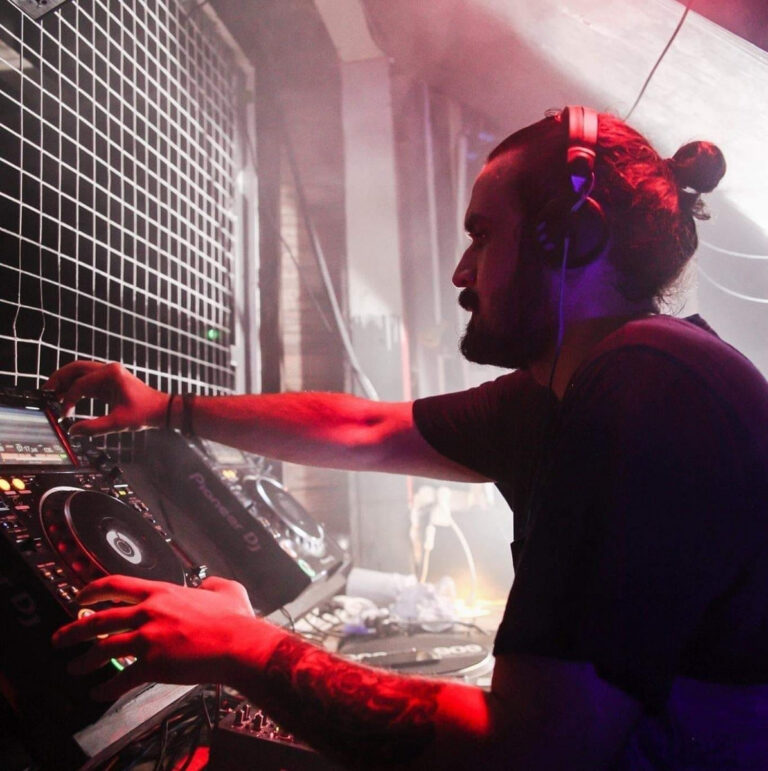
Bucharest’s Triptil belongs to the second generation of ro-minimal producers — those long, hypnotic grooves built patiently in the studio, backed by names like Barac, Nu Zau and Janeret, and released on labels from NG Trax to the anonymous TELUM. First brought to Budapest by Rokoko, he returns on July 18 for the Fidull x Telum Open Air. We talked studio gear, opening a set, the shifting Romanian scene, and the strange magic of hearing your own track out in the wild.
Is there such a thing as a Triptil day with no music in it at all? Or is music already there with the morning coffee?
There isn’t really a day without music for me. On weekends, I usually start my day with a cup of coffee while listening to music. Later in the afternoon, especially on weekdays, I spend time either listening to music or making my own. Music is an important part of my daily routine and something I enjoy every day.
How hardware-based is your workflow? Describe your studio for us: what surrounds you when you work, and is there one piece of gear you couldn’t imagine making a track without?
My workflow isn’t strictly hardware-based—it really depends on how I’m feeling at the time. I like to let the creative process happen naturally rather than following a fixed routine. Most of the time, I rely on my Elektron gear for creating ideas and building tracks, while Omnisphere is an essential part of my setup for its versatility and inspiring sounds. I couldn’t imagine making music without those tools, as they perfectly complement the way I work.
You’ve also released on Telum, a fully anonymous, vinyl-only label. What was it like making music for a place where your track reaches listeners without your name on it?
„Without my name attached to the release, listeners could focus only on the track and their own connection to it.”
Releasing on Telum was a unique experience because it allowed the music to speak entirely for itself. Without my name attached to the release, listeners could focus only on the track and their own connection to it, free from any expectations or preconceptions. I think there’s something special about that kind of anonymity—it reminds us that the music is what truly matters. For me, it was a refreshing and rewarding way to share my work.
Your early records have become collector’s items, hunted down on second-hand lists. How does it feel that someone pays more for an old Triptil record today than it cost on release day? And do you even own a copy of each one yourself?
It’s honestly quite surreal. When I made those records, I never imagined they would become collector’s items or sell for more than their original price. It’s a great feeling to know that people still appreciate and search for them after so many years. To me, that’s a sign that the music has stood the test of time, and that’s far more meaningful than the price itself. And yes, I still have a copy of every release—those records are an important part of my journey, so I always made sure to keep one or two.
There’s that special situation when you hear your own track under someone else’s hands at a party, out of nowhere, especially when it’s played by someone you look up to. Has it happened to you? Where was it, and who was playing?
„There was something magical about stepping into the new year while hearing my own music filling the room.”
Yes, it has happened twice, and both times were truly unforgettable moments.
The first one was in Brașov on New Year’s Eve. What made it even more special was the timing—I was walking into the party at around 00:05, just after midnight, and I suddenly realized one of my own tracks was playing. There was something magical about stepping into the new year while hearing my own music filling the room. I don’t remember exactly who was playing that night, but the feeling itself stayed with me.
The second time was at Picnic Fonic, when Sepp was playing. As I was walking towards the beach tent, I could hear my track from outside before even entering. There’s something incredibly special about approaching a party and hearing your own music coming from inside—it’s a feeling that’s hard to describe.
Those moments are a beautiful reminder that once you release a track, it starts its own journey. Seeing it connect with people, being played by artists you respect, and becoming part of someone else’s memories is one of the most rewarding feelings as a musician.
How do you open a set? Do you have a go-to recipe for the first half hour, or does it all depend on what you see in the room right there?
I don’t really have a fixed recipe for opening a set. For me, it depends a lot on the moment, the place, and the energy I feel from the room. I like to take my time in the beginning, understand the atmosphere, and slowly build a connection with the crowd rather than forcing a direction. Every space has its own character, and I think the best sets come from being present and reacting to what’s happening around you. Sometimes the first track can completely change the direction of the journey, so I prefer to stay open and let the music guide the way.
You see the Romanian scene from the inside, the place where this sound was born, while minimal keeps drifting towards a more popular sound than it had a few years ago. How do you experience that shift, and where do you think the scene will be in five years?
The scene has changed a lot over the last few years. I feel like the Romanian sound is moving more towards the minimal house side, while still keeping strong underground influences and the identity that made it special in the first place. Personally, I enjoy seeing this evolution. Music is always changing, and I think it’s important for a scene to grow, explore new directions, and adapt with time. I believe it will continue to evolve in the coming years, and I’m curious to see where this journey takes us.
Your first Budapest gig came through an invite from Rokoko. What memories do you keep from that night and the Hungarian crowd? Was there anything that surprised you?
„People were not just there for the party, but genuinely connected to the sound and the atmosphere.”
My first gig in Budapest, thanks to the invitation from Rokoko, was a really special experience. I didn’t know exactly what to expect, but I remember feeling a strong connection with the crowd from the beginning. There was a great energy in the room and a real appreciation for the music. What surprised me was how open and involved the Hungarian crowd was. You could feel that people were not just there for the party, but genuinely connected to the sound and the atmosphere. It was a beautiful experience, and it definitely left me wanting to come back and share more music there.
Now you’re coming back for the Fidull x Telum open air, an outdoor setting this time. Do you prepare differently for an open air than for a club night? And is there anything you’re working on right now that we might hear first?
„There is something special about being outdoors—the atmosphere, the connection between the music and the environment, and the freedom that comes with it.”
I never really prepare a set in advance. Of course, I always dig for new music and have an idea of what I want to bring with me, but you never truly know what’s in front of you until you’re there and you feel the energy of the crowd. I always try to arrive earlier before my set starts. For me, it’s important to get familiar with the sound, the space, and the people. It makes it much easier to adapt and understand the direction the night is taking. When it comes to open airs, I have to say they are some of my favorite experiences. There is something special about being outdoors—the atmosphere, the connection between the music and the environment, and the freedom that comes with it. Those moments can create a very unique energy that you don’t always find in a club.
Triptil’s music is available on Bandcamp and SoundCloud. Thanks, Triptil — see you on July 18!

Fidull x Telum Open Air
July 18, 2026 | SPOTX, Budapest
Triptil plays alongside Fedo and TELUM (Lee Clement).